














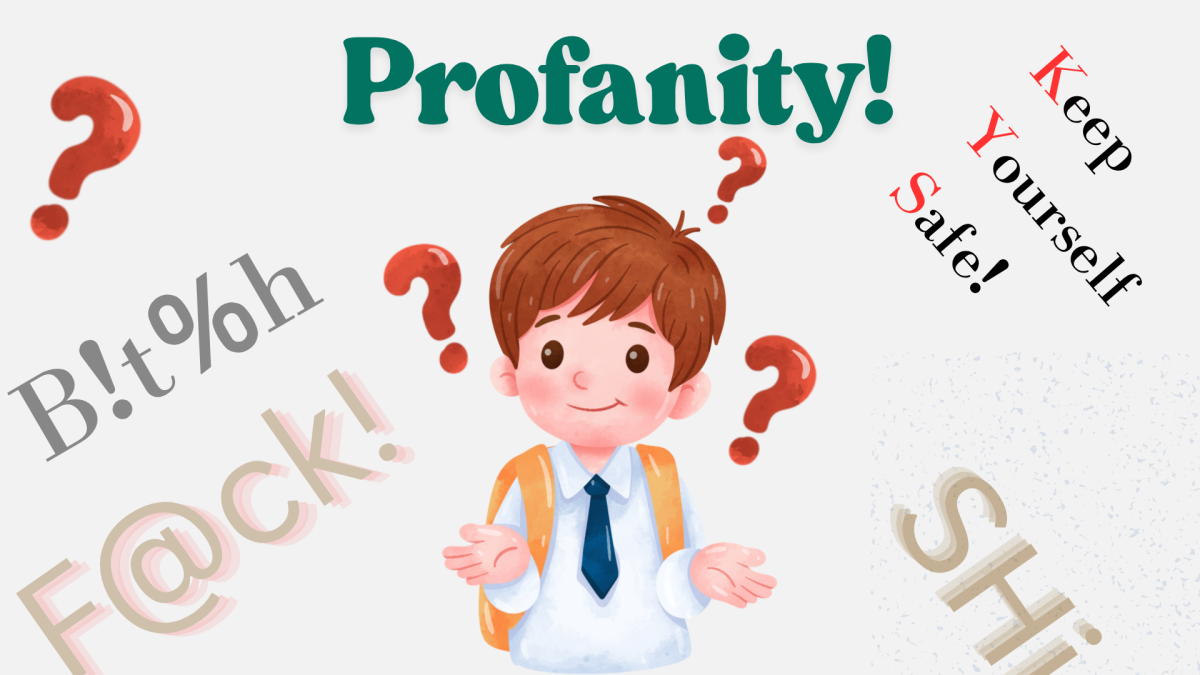
An expression of the First Amendment or clear attempts to disrupt the peace? Profanity at school has been demonstrated to become more common throughout the year as exposure to the internet seems to rise. But is it necessarily a bad thing? Is it just normalized speech that poses no threat? Many have different opinions on how profanity affects the school environment and whether teens should be using it. From concerns to acceptance, let’s dive deeper into how common it is at MCHS and what others think of it.
The Parent-Pupil Rights and Responsibilities Handbook states that students should, “At no time use profane or vulgar language or make obscene or suggestive gestures.” This means that swears, suggestive language and actions are banned and could subject students to disciplinary action if they violate these rules.
However, even with the rules in place, some students and teachers say that the use of profanity has been noticeably increasing.
Yearbook and English 11 teacher Chyna Tran states how there has been an increase of profanity usage recently and how it is not acceptable in the academic setting.
“I’ve been noticing an exponential increase in the use of daily vulgar language and profanity. It’s changing the culture and the environment of the school. … It’s an academic setting and academic language should be used,” Tran said.
Tran continues to explain how the use of vulgar language affects how others perceive someone, whether it’s in a positive or negative light.
“People get judged based on the language they use. If I am someone who uses vulgar language every second, a lot of people can assume or will assume that they don’t have any class or respect because of their vulgar language,” Tran said.
The use of profanity has also been stated to be quite disruptive in an academic setting.
Junior Juan Pineda shares his opinion on how profanity is disruptive.
“I think it’s become more disrupted because the students are yelling more often. Students are louder, because of that you hear cursing. I think if you whisper it, then it’s not disruptive because you would not call whispers as something that’s disrupting the class,” Pineda said.
While profanity does have a correlation with disturbance, some may advocate that profanity is not the main reason for those disruptions.
Junior Angelina Reyes states how disruptions stem from lack of control and manners.
“I think people are just disruptive in general, even without profanity. A lot of people seem to lack consideration and respect and, I guess, self-control basically. I think there has been a rise in more disruptions,“ Reyes said.
Reyes continues to share their thoughts on how they don’t mind the usage of non disruptive profanity, but should still abide by the school rules.
“I know not everyone has that same mindset so I think we gotta be careful with that. I don’t mind the usage of profanity as long as it’s not disruptive, but if school rules say that we shouldn’t be using [it] in classrooms then we shouldn’t. I think we all gotta maintain a certain amount of respect,” Reyes said.
Pineda explains a belief for who uses profanity and who shouldn’t, highlighting the four year age gap with students at MCHS.
“I think it’s really dependent on the fact that there’s a range of four years here. There are the itty bitty freshmen who are fresh out of middle school, they shouldn’t be using [profanity]. But then you have seniors who have jobs and genuinely hate some aspects. They gotta do everything,” Pineda said.
Reyes states how they believe the school should focus more on the meaning of how one uses profanity, and they might explain that the usage of curses does not necessarily define the idea they mean to say.
“I suppose they could be stricter not necessarily on profanity but just on what people’s words mean in general. Y’know, profanity doesn’t necessarily mean it’s negative. And the opposite is true, just because some aren’t using profanity doesn’t mean their words are positive,” Reyes said.
While there is a usage of profanity in conversations, scholars seem to be respectful of people’s boundaries and understanding enough to stop.
AVID 11 and English 10 teacher Jennifer Larocque explains how she believes most kids are mature enough to take initiative to stop profanity.
“I think that most of the kids here are pretty good that if you hear the use [of profanity] you just remind them that it’s not appropriate and to stop,” Larocque said.
Profanity will continue to be used and repeated, but what matters most is that we keep our community here. MCHS should continue to have a strong community, not letting the use of profanity divide us all.
“The kids and the staff here are lovely. Any kind of topic, whether it’s profanity or anything else, people are very respectful here and if they have problems with things they talk it out. I don’t see any disagreements or loss of friendships over a curse word,” Larocque said.