















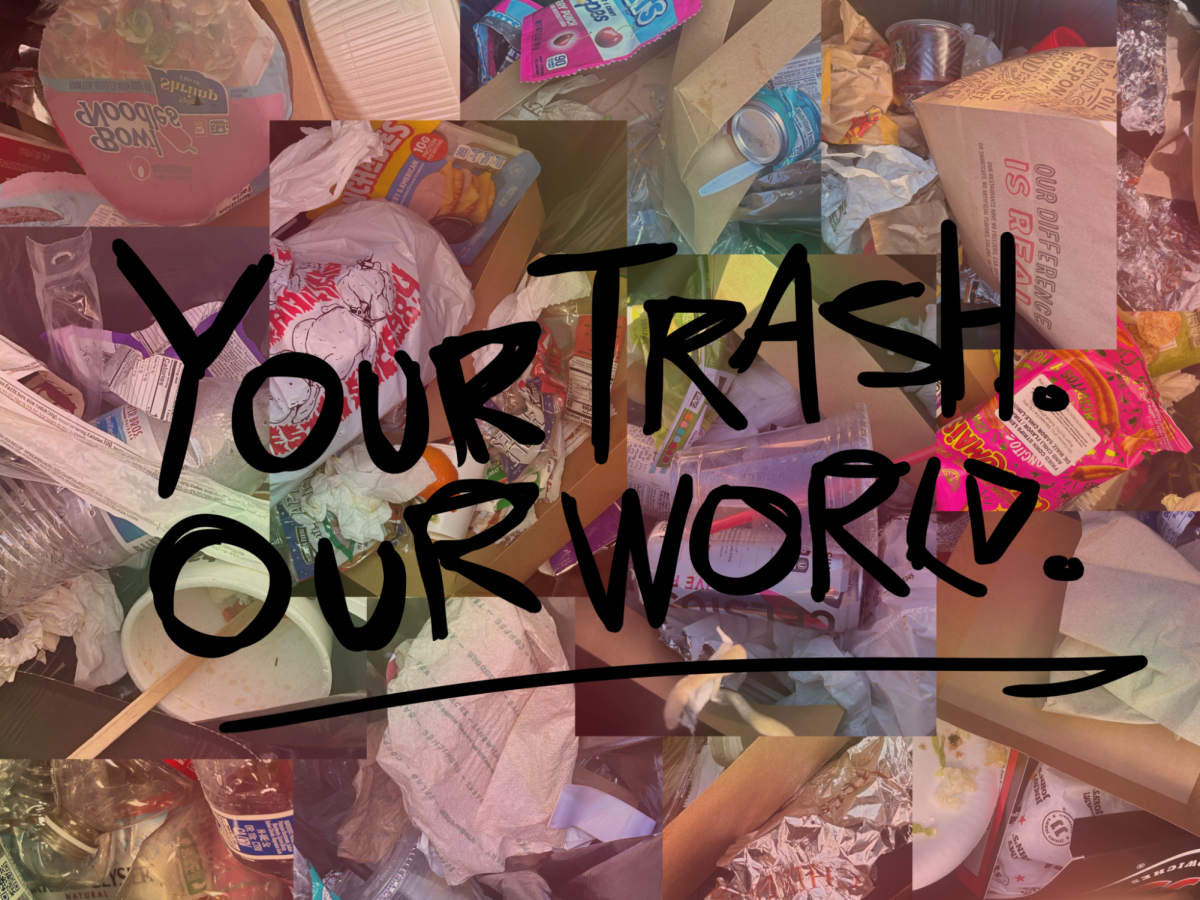
Out of sight, out of mind. Whether intentional or not, this mindset is something that contributes to so many of our daily actions. Through time, such a mindset has had backlash to Santa Ana’s means of sustainability and management of waste. With all the items we purchase, it is vital to note the ways in which the community disposes waste and seeks to recycle items to further use.
Unbeknownst to many, Middle College High School relies on the waste management system of Santa Ana College, a system different from the city as a whole. Despite this, community members all note similar flaws in means of organizing waste. The city’s distribution of waste has resulted in environmental consequences that haunt the community through minimal attention and differences in priorities. Although bleak, members of the community find hope in potential changes that can go a long way to creating a bright future for what it means to effectively dispose of waste and recycle.
One of these members is Santa Ana College’s Adjunct Professor for Human Ecology, Professor Skelly Moore. Moore has been conducting environmental research for over 30 years. Alongside teaching college students on sustainability, Moore has acted as the former executive director for the Moore Institute for Plastic Pollution Research. Moore recognizes that in recent years, students of Santa Ana College have been seeing recycling implemented in modern classrooms as a means of organizing waste.
“I know that there’s always been the different trash cans, at least in the newer buildings where they have recycling waste versus regular waste,” Moore said.
Such a system of design portrays Santa Ana College’s means of waste management as a working system to the public eye. However, this system holds a truth beyond simply organizing recycling and waste. Middle College Custodian Luis Macedo, has acted as the school’s primary source of waste management. Macedo describes his experience in regards to Middle College and Santa Ana College’s waste management and the flaws in such a system.
“It’s not like two separate trucks come and pick it up,” Macedo said. “It was always the exact same truck that would just pick up both bins.”
Although many assume these bins are to be organized and filtered efficiently, this isn’t always the case.
“They may be separate, but when they get actually taken to the landfill and looked at, most likely, it all goes into the landfill and very little will go into being recycled,” Moore said.
Middle College and Santa Ana College’s system of waste management holds flaws. However, it isn’t an issue pertaining only to the college but as an issue for the city as a whole.
“Recently, they got a new company. I think this might even be a different company than the normal neighborhoods around here,” Macedo said.
Although companies with different intentions and means of waste management, both handle waste in the same way.
“Those bins you put out at your curb full of recyclable materials, most of them go to the landfill,” Moore said.
The way Santa Ana handles recycling and waste as a city contributes to deeper environmental consequences that the world bears through. Many members of the community note this issue and concern the lack of sustainable approach. Specifically, the waste that goes into landfills have issues within their system of design.
“There’s a number of problems that can happen with landfills. They do put some protection down underneath them and try to keep leakage at a minimum,” Moore said. “But, sometimes [leakage] happens, and it can contaminate our groundwater. We also have a lot of off-gassing of methane from landfills.”
The result of this inadequate protection are communities around Santa Ana that endure poor water quality and air pollution unbeknownst to them. Such effects affect the community’s residents as highlighted by plastic visibility in the soil and produce grown locally.
“We recently worked at the Moore Institute on a project from [nine] compost facilities in the Bay Area… and we tested the compost for plastic. We found that pretty much all of the compost had plastic in it, and some had way more than others,” Moore said.
These contaminants have even gone as far as reaching local aquatic life and impacting their health. Blanca Suarez, acting as Middle College’s representative for Family and Community Engagement (FACE), has thoroughly engaged with families and people connected with Santa Ana Unified School District. Suarez notes the desires of community members in regards to sustainability in waste management and points out the effects of waste out in the world.
“A lot of waste ends up in our oceans,” Suarez said.
The presence of microplastic and other contaminants are of the most devastating environmental impacts that can affect human health as the youth develop. Unfortunately, with such little knowledge, many Santa Ana residents don’t realize how close this is to the city’s population right now.
“A lot of times [landfills] will be made into parks, and people don’t even know what’s underneath their feet as they’re walking,” Moore said. “If we don’t do something soon, it’s gonna get worse and worse.”
Despite desired advocacy from community members to make changes in the way we recycle, there are issues with creating an effective system. Unfortunately, Santa Ana’s waste management companies don’t hold as strong of an intent to recycle as citizens fight for.
“Recycling costs money, and that’s why a lot of it doesn’t get done but it’s absolutely necessary,” Moore said. “It’s all about money. In many cases, they’re just gonna come and pick it up and get rid of it.”
Despite how simple throwing away trash is, the intricacies of making that product back into something usable is tedious and often costly. Some of the smallest flaws will make a recyclable inefficient to turn into something usable.
“Oftentimes the plastic has to be clean. If there is food waste in it, they’ll just send it into the landfill,” Moore said. “The other thing is that, oftentimes there’s mixed plastics, mixed polymers, and that’s harder to recycle so they won’t recycle those as well.”
To add on to such extreme standards to effective recycling, advocacy to ensure recyclables are being truly recycled isn’t as strong as it should be. Unfortunately, many residents will embody optimism that recycling is a working system.
“Unfortunately, a lot of people nowadays just kinda stick their head in the sand, and if they don’t know about it, then they don’t have to worry about it,” Moore said.
Although Middle College and the entirety of Santa Ana holds a flawed system in the way waste is managed, change towards the right direction is still on the table.
“As a district, we are trying to search ways to have more recycling in schools,” Suarez said.
As a school, students of Middle College High School have potential to create strong environmental change as a union. Despite barriers, sustainability is still possible.
“A lot of students purchase items from the Johnson Center,” Suarez said. “I feel like we can recycle those cans. We might not be a big school but I think we can still implement that.”
As aspiring people with bright futures, having the world’s health be a core component to all goals should be an ideal to hold onto. Changing the way in which you approach waste can be a grand start to creating a greener future.
“I would challenge the students to look at how much waste that they’re generating and see if they can find ways of minimizing it to not having so much,” Moore said.
When it comes to everything you leave behind in life, it is vital to think of where you foresee that item at. Do you want it at a place where it can continue being used by others or in the air and water you intake daily? Creating a world with effective waste management and recycling is a true necessity for Middle College students and beyond.