






Picture yourself walking into a record store. The door chime rings as the door gently creaks open. Inside, the faint smell of paper is immediately distinct, and the lights are reminiscent of a liminal space that is familiar yet cannot be recognized. Subsequently, the “hello” of the shopkeeper echoes throughout the room as rows and rows of vinyl records, cassettes and CDs stretch seemingly forever and the crackle of a vinyl record evokes a nostalgic atmosphere. It is a world that one can get lost in eternally.
Experiences like this have become more prevalent as the physical music media market has slowly, but surely, been making a comeback. After the vinyl boom, where records and other physical mediums reemerged in the market and accelerated throughout the COVID pandemic, there has been revitalized interest in physical music for various reasons, posing questions about the future vitality of this market.
According to Luminate, one of the most prominent music sales tracking companies in the U.S., physical music sales — consisting of formats such as vinyl records, cassettes and CDs — increased by 6.5 percent in 2025 to 82.2 million units. Vinyl records specifically increased at a larger percentage of 8.6 percent to 47.9 million units, which made up over half of physical music sales overall. This marked 19 consecutive years in increased vinyl sales. Additionally, Luminate reported that out of these vinyl sales, more than 40 percent were sold through independent record stores.
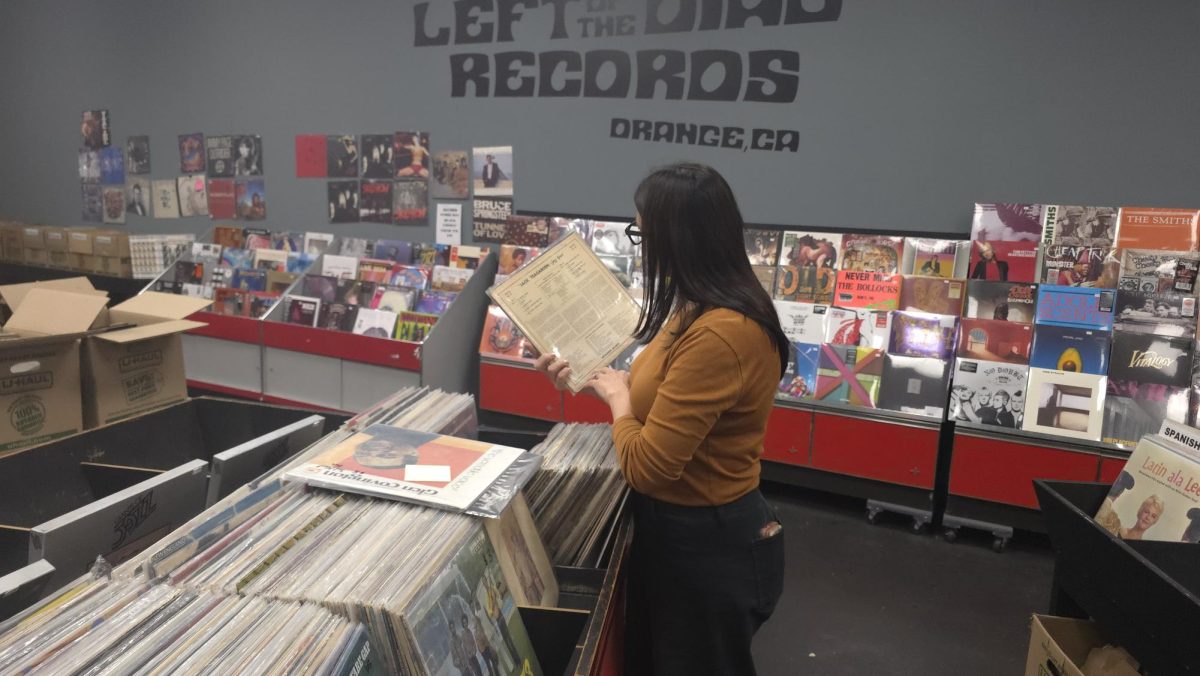
One such store is Left of the Dial Records, located in Orange, California. A staple in downtown Santa Ana that switched ownership in 2017 and later relocated, the store specializes in used records, with around 95 percent of its stock being pre-owned, as well as selling audio equipment.
Current owner Bill Michelle, 64, describes himself as a “70s rock guy” and describes his introduction to physical media as a result of observing his brother experiment with audio equipment.
“I had an older brother who was a tinkerer, and he and I used to take speakers apart. This was about when I was seven or eight. I would use a soldering iron to put different capacitors on, and we’d do different things. He knew all about electricity and voltage and sound, and I was just fascinated by it all, so I got into records and gear when I was about eight or nine,” Michelle said.
With his newfound appreciation for records and audio equipment, he was able to build a stronger connection with his brother. Wanting to share his passion for music with others, he bought Left Of The Dial to allow for further opportunities to create connections through this shared interest.
Michelle highlighted this sentimental value of physical media collecting by sharing a story where he talked with someone all the way from North Carolina.
“She visited. I was nervous. I’m like ‘What if she doesn’t like my store? What if she just saw my videos of records and she thought that was cool, but the store is disappointing?’ She was here three times in six days and spent, like, $500,” Michelle said.
Adding to the sentimental aspect of physical media, Michelle highlighted how vinyl records specifically have additional content added to the packaging aside from the music itself. This extra content provides a behind-the-scenes look that enhances one’s connection with the music.
“Records are, with lyric sheets and things, and nicer artwork than CDs or [cassette] tapes… more fun to look through and collect,” Michelle said.
One person who shares this experience of wanting a deeper connection with records beyond the music itself is Junior Erick Rodriguez, who started his physical media collection when he was in 7th grade. Rodriguez collects vinyl records of a variety of genres, including rock, soundtracks, and Spanish records. To date, he has collected 50 vinyl records.
“I listen to a lot of old music. Back then, when they would release music, they would press it on vinyl, right? They couldn’t have it digitally… So, I was like ‘Let me see how the artist intended for their music to be heard and how people used to listen to it,’” Rodriguez said.
Rodriguez was interested in bringing his listening environment closer to what the artist intended, which resulted in his hobby of collecting old vinyl records. Additionally, the purchase of an old record would preserve the music in its original form against any potential future alterations.
“With a streaming platform like Spotify, you don’t ‘own’ the music. You might, like, pay to have Spotify Premium and have no ads, but at the end of the day, if they take the music off of there, then you’re kind of cooked since you’re not going to own it,” Rodriguez said.
Aside from ensuring that the music he listened to didn’t go away, owning records came with the benefit that he would be able to further connect with the music. By financially investing in a release, he wound up feeling more attached to it.
“I think with owning something like a record, a CD, or a cassette, you really pay attention to the art a lot more, as opposed to when it’s on digital, you’ll just have it on in the background,” Rodriguez said.
However, according to Michelle, the level of commitment required for physical music collecting can be a double-edged sword, as it may dissuade people from entering and consuming in the market. Michelle made sure to highlight a key, but often overlooked issue of vinyl collecting, which is storage.
“One [of my customers] was slowed down by their wife because the records were taking over the house. He didn’t have proper storage. So, that’s another issue. If you do get into it and then suddenly, if you’re buying a stack of 30 or 40 [records] every week, well, guess what? You can’t listen to them and put them into your system yet, so they’re going to be all over the place,” Michelle said.
He additionally shared how the reselling value of vinyl records may not be what people are expecting, which can be a challenge that elevates how committed one must be to their purchase.
“People think they’re worth a lot more than they’re worth. People bring me flea bin records and want ridiculous amounts of money for it,” Michelle said.
Additionally, the level of financial commitment that one must devote to records has been growing further and further. With recent trends, it has become harder to begin collecting because of the increasing prices when it comes to vinyl.
“With the cost of housing, food, and what have you, young people don’t have the extra income to get into the hobby… We can all like music, but you have to make a commitment if you want to start playing $90 [for vinyl] for your favorite music, when it’s sitting out there [on CD] for $5 or you could stream it,” Michelle said.
This effect has also been observed by Rodriguez, as he has also noticed the rising prices of vinyl records. Even with standard records that are not exclusive, he has seen prices increase in the market.
“Some cons with the physical media market growing and stuff is that things have become more expensive. The average record is probably going up. I’ve noticed with especially newer artists, when they release records, it’ll be like upwards to $30,” Rodriguez said.
Rodriguez partially connects the increase in prices to an oversaturated market, which, to him, is an artificial rise caused by artists releasing an excessive number of records.
“An artist will press their new album on, like, 10 different colors and they’ll do, like, five different alternate covers, and it’s, like ‘What’s the point of that?’ and I think that takes away from the art form,” Rodriguez said.
With the physical media market trending, prices rise and it can seem dissuading for some to enter or to begin selling it. However, for Zach D., the 22-year-old co-founder of CD-producing and distribution company Big Things ITW, this market is one of untapped potential. Originally creating CDs as a favor for his musician friends, he decided to turn his hobby into a business last year to both capitalize on an emerging market and support independent artists with limited resources.
“I would hang around this group called ‘limewire exclusive’, which is just a bunch of small indie rappers, and a consistent problem I noticed was, like, they wanted to make physicals for their albums, but most places that you could get CDs from would be in bulk or have a really high price point,” Zach D. said.
Charging no upfront cost and instead taking 30 percent of royalties from physical sales, Zach D., through his company, prioritized an artists-first approach. Through this, he wished to highlight the advantages that physical media has in artist empowerment and combating against controversial industry practices.
“[Spotify]’s payout methods are really bad. It’s less than a cent per stream… Y’know, these guys need to eat. So, the pros for CDs are that they’ll make artists more money,” Zach D. said.
Especially following the acquisition of WhoSampled, a website that revealed copyrighted samples in music, by Spotify and the backlash following this decision, Zach D. emphasized the role that physical media can have in sharing music that may face copyright issues.
“I have a bunch of, just like, some little beats that I made that are essentially just remixes of songs, and I couldn’t put them anywhere. Maybe Bandcamp, but I don’t know how the copyright rules are there. So, I could just put them on a CD and sell them… That is absolutely something we could offer. It’s like ‘Hey, listen. We’re just a tiny little website, if any major sampling thing is going to come over and kill you for it,’” Zach D. said.
Regarding the future of the physical media market in general, Zach D. remained optimistic. He expressed the belief that as long as there is music being made in general, regardless of any issues that may come up, there will be artists wishing to create tangible works and people wanting to support them.
“I think most musicians who have projects would love to just be able to hold it and be like ‘Yeah, I made that.’ So, I think generally, as long as musicians are putting stuff out, they’re gonna want to make CDs. It’s just a matter of, like, do people want to buy them? I hope that is the case,” Zach D. said.