











Most people have what are called “shower thoughts”—moments when random questions come to mind. Why did society evolve the way it has? How does technology like Bluetooth actually work? What mysteries still exist in the deep ocean? These questions may seem small, but curiosity like this sparks deeper analysis about the world around us.
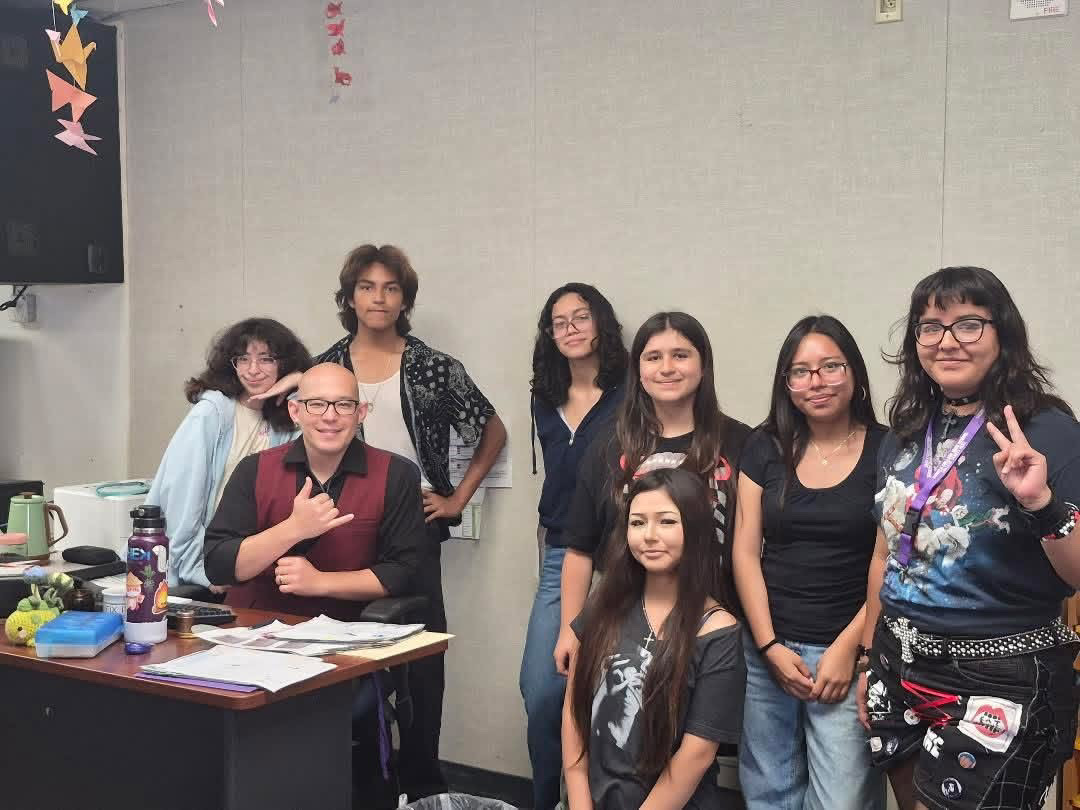
10th grade history teacher Kealakekua Moa introduces the idea that history always starts by questioning.
“It all starts with a question when approaching history: How and Why?” says Moa.
“If we can understand the origin of something, it’s easier to understand the world around us,” Moa said.
Moa’s perspective highlights that history does not necessarily stay in the past, instead it creates a stream of patterns involved in understanding society and human behavior. Moa’s emphasis on curiosity shows that learning history helps us think critically and contextually about the world today.
History is not just something found in textbooks—it’s still in our everyday lives. The way society works today is built on past decisions, mistakes, and discoveries. Phrases like “history repeats itself” and “we learn from our mistakes” may sound contradictory, but they actually overlap. In order to learn from our mistakes, we have to analyze the patterns of history– in order to prevent repeating bad mistakes. However, we can also recognize the methods that work to improve our current society. Humans recognize patterns from the past and use them to guide future actions.
Background
This behavior can be traced back to early human evolution. The brain’s ability to detect danger and remember past experiences helped early humans survive. Over time, this same instinct influenced how societies developed—learning from failure while also repeating familiar patterns.
“Being able to humble yourself to the truth and the ability to seek and find it shows great maturity,” Moa said. “If we all had this mindset, the world would be a much happier place.”
Here, Moa brings out that history teaches humbleness and critical thinking. Recognizing the patterns of success and failure in the past encourages us to make wiser decisions today, not just memorizing events.
As civilizations grew, ideas like personal idealism began shaping history. Leaders such as Alexander the Great and Joseph Stalin used their visions to expand power and influence systems. These moments show how an individual’s beliefs can create lasting global effects.
These historical figures, among many more, paved the way for human civilization; however, they’re not as heavily recognized as they should be. History is not separate from the present because it actively shapes politics, technology, and social systems.
Historical Events Overlapping
Historical events are deeply connected to the world we live in today. The standard systems, values, and technologies that have shaped modern society did not appear suddenly; they developed over time through time of overlapping evolution. Each creation builds on the last, creating an influence that continues to affect how people live, think, and govern themselves. While some events may seem separate, they are all linked through progress and conflict.
Early Transformations
Some of the earliest transformations in human history lay in the starting point for an organized society. The Agricultural Revolution allowed humans to shift from hunting and gathering to farming, leading to population growth as they had more than one type of sustenance. As communities became more stable, the need for communication and record-keeping increased. This led to the development of writing systems such as Egyptian hieroglyphs, Chinese characters, and the Phoenician alphabet.
These innovations overlap with modern society through structured governments, education systems, and written communication. The ability to document information and share ideas remains essential today, showing how early human developments have evolved and continue to influence daily life.
Political Turning Points
As societies grew, political systems began to take shape. One of the earliest examples of citizen involvement in government appeared in Athens, where democracy began around 508 BCE. Although limited at the time, it introduced the idea that citizens could participate in decision-making. This concept became the foundation for modern democratic governments, where voting, public debate, and civic responsibility are still key elements.
“We are still making many of the same mistakes of the past,” said Rafael Ramos, 11th grade history teacher. “The same forces and conditions that existed then still exist today.”
Ramos’ observation emphasizes that political systems evolve, but human behavior and societal challenges usually repeat. Studying these patterns helps us predict outcomes and improve.
Later, the Fall of the Western Roman Empire marked a major shift in European history. The collapse was caused by economic struggles, military weakness, and political instability. As a result, Europe fragmented into smaller kingdoms and feudal systems. This transformation influenced the development of modern nations and political boundaries, demonstrating how instability in the past can reshape entire regions for centuries.
Knowledge and Communication
The spread of knowledge played a major role in shaping modern society. The invention of the Printing Press revolutionized the way information was shared by making books and newspapers more accessible to the public. This invention increased literacy and allowed ideas to spread rapidly across societies.
This expansion of knowledge directly contributed to the Scientific Revolution, a period that emphasized observation, experimentation, and evidence. Influential figures like Galileo Galilei and Isaac Newton challenged traditional beliefs and encouraged critical thinking.
These developments continue to overlap with modern life through advancements in science, medicine, and technology. Today’s reliance on evidence-based research and innovation can be traced back to this period, showing how the pursuit of knowledge remains a central part of society.
Industrial and Political Revolutions
The Industrial Revolution marked a major turning point in how people lived and worked. The introduction of steam-powered machines transformed manufacturing, leading to urbanization as people moved to cities for jobs. This shift created industrial economies and changed social structures, many of which still exist today in the form of modern industries and urban life.
“The eight-hour workday, public schooling, and urban life all come from the Industrial Revolution,” Moa said. “Many people don’t realize that this single event created the foundation of the lives we live each day.”
Here, we can see that many aspects of our daily lives are factors of historical change. Understanding their origin allows us to examine societal norms and labor practices.
Political revolutions soon followed, reshaping ideas about power and government. The American Revolution established the idea that people could govern themselves without a monarchy, promoting values such as freedom and independence. These ideas inspired other nations to challenge authority and seek self-rule.
Similarly, the French Revolution pushed forward principles like liberty, equality and citizenship. It marked the fall of the absolute monarchy and the rejection of the divine right of kings. These revolutionary ideas continue to influence modern democratic systems and human rights movements around the world.
Global Conflicts
Now, we have two major wars in U.S. history, World War I and World War II. World War II was the first large-scale industrial global war, with the outcome of four empires falling (German, Austro-Hungarian, Ottoman, and Russian). The main cause of this war was the Treaty of Versailles affecting Germany’s economic collapse and resentment that would eventually lead to World War II. The outcome of this war was certainly the result of World War II.
As for World War II, it became the deadliest war in U.S. history, with the holocaust introducing nuclear weapons and the U.S and the Soviet Union becoming powers, along with the creation of the United Nations. With the nuclear age uprising, it was made known that future wars may end human civilization, shaping today’s international relations.
Late 20th Century Change
Although we are not far from this recent historical event, known as the Fall of the Berlin Wall in 1989. This event meant the end of the Cold War, leading to the collapse of the Soviet Union and political changes in Eastern Europe. Allowing communist countries to transition into democracies.
Modern Transformation
Now we have modern ripples in our society, such as the internet and artificial intelligence. Both these transformations play a major role in students’ and adults’ everyday lives. The internet was introduced in 1991, connecting billions of people globally. It revolutionized communication, information sharing, and many industries. As for Artificial Intelligence (AI), it has generated many tools and influences education and workplaces. While it has helped people’s lives become more efficient, it has also raised the question if it is adapting for the better.
“Curiosity about how people lived and behaved drives understanding,” Moa said. “This same approach helps us navigate new technologies and societal changes today.”
The quote ties history to modern technological developments, showing that understanding past innovations and societal reactions can guide responsible and informed use of modern tools.
History has played a huge role in human evolution and it still stands strong today. For example, the global internet comes from the Cold War, democratic rights came from struggles of ancient Athens, and through revolutions, our eight-hour workdays came from labor during the industrial revolution, the foods we eat came from the Columbian Exchange, and the medicines we consume exist because of the Scientific Revolution.
Importance of History in School
History plays a large role in understanding the world in children’s education. It’s the blueprint to unlock their aspirations of becoming future leaders. Students come face-to-face with real-life examples of bravery and selflessness on a day-to-day basis. With history, the generation’s future leaders build morals.
It’s the understanding of knowing how we got and live the way we do. Not only do we learn about our own achievements and downs, but we also learn about different cultures and perspectives, which grow critical thinking skills and empathy.
“History is always about seeking the truth, not to prove a point,” Moa said. “We’re answering the question of why and how, then applying what we’ve learned.”
This quote deepens the point that history is active learning. Students who actually engage develop the skills and judgement to navigate complex societies.
Students are also able to recognize the patterns and implications of decisions to gain wisdom from failures and the methods that led to success. This is why history is key to character development in students, as they become well-educated citizens to maintain and secure a democratic society.
Takeaways
Overall, one can see how historical events help us understand our world’s evolution. It exposes our brains to different insights about present ideas and questions. Everyone is part of a country, religion, groups, and professions with different belongings.
While our world has faced many unfortunate events, it’s interesting to think about how our world would look today if they had never occurred. When we make sense of our and others’ societies, it allows us to feel empathy and pride. Studying history lets us distance ourselves from old mistakes–ultimately moving on and inspiring us to be better.
Of course, we can experience the world seemingly, with no understanding of ecosystems. However, while it may appear pretty, it’s incomprehensible and shallow. This is because this world is made up of history and past knowledge. The joy of history is not in questions, but the answers.
“History is important. If you don’t know history, it is as if you were born yesterday,” Ramos said, quoting historian Howard Zinn. “And if you were born yesterday, anybody in power can tell you anything, and you have no way of checking up on it.”