

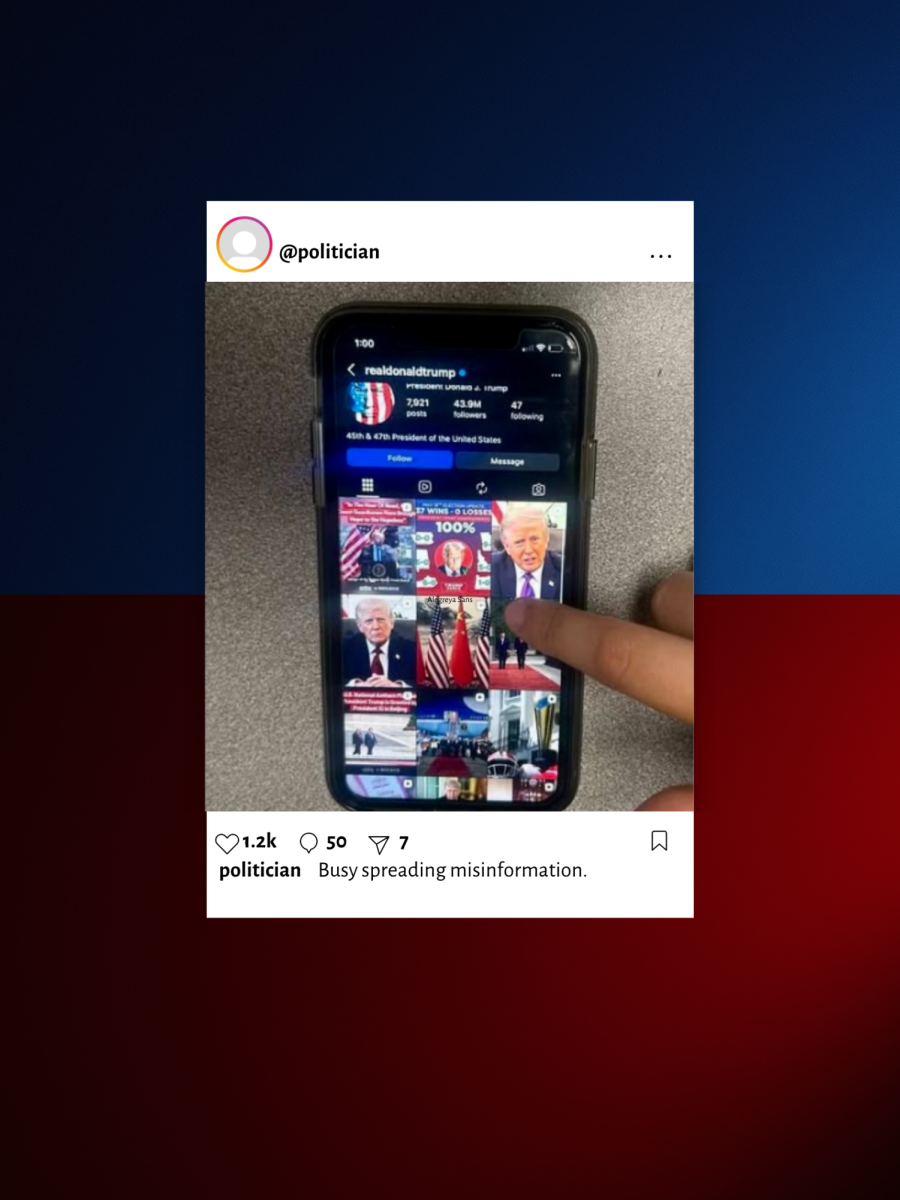









The headlines seem to never end. Climate change, the world is ending, gun violence, economic uncertainty, immigration. From TikTok to Instagram, they flash across screens in bold, urgent text and increasingly, more young people scroll right past them.
For some of Generation Z, the constant drumbeat of crisis has produced not urgency, but exhaustion. What was designed to inform has instead bred apathy. And as this generation ages into political power, a troubling disconnect is growing between young people and the political systemics that shape their lives
Yara Haquet, senior at Middle College High School, shares how social media makes her feel about politics.
“I feel like social media sometimes makes students feel overwhelmed,” said Haquet. “It makes it [politics] hard to engage with.”
This disengagement does not exist in a vacuum. Advocates for civic education and young organizers point to a broken pipeline that starts long before Election Day — in the classroom. Mia Verdin, Santa Ana Youth Vote Co-Director (a group encouraging non-partisan voter registration) and University of Berkeley class of 2027 shares her insight.
“I would say our curriculums in school are definitely not as robust as they should be,” Verdin said. "I remember so vividly my senior year; it was literally an election year. It was fall 2022, and none of the like eight AP government teachers were really encouraging any sort of involvement or education."
Verdin's experience is not unique or unexpected. In 2002, the No Child Left Behind (NCLN) Act took place. Due to the NCLN funding became tied to test scores in math and readings. Civics seemed to have decreased. With social studies in general receiving a 36% decrease in time throughout school districts.
Additionally, teaching civics does not have to be biased. The problem is not endorsing a specific political candidate, rather it is the lack of support for civic education.
"Obviously you don't have to endorse candidates or anything, but they also weren't encouraging like, 'Hey, look who's on the ballot this year.' There wasn't any sort of initiative there," Verdin said.
Without teaching civics in high school, it results in a generation that understands the government structure but not the importance of voting. This can lead to distrust amongst the government and weak hope for political change.
"We're learning about the government, how these structures actually function and how they historically have functioned, but we're not actually learning about what impacts us today," Verdin said.
Part of the problem, Verdin argues, is a cultural obsession with federal politics at the expense of local races. For example, during the Santa Ana Special Recall Election for Jessie Lopez, out of 26,762 Registered Voters only 6,863 ballots were cast. That is equivalent to 25.6%.
"There's just an overemphasis on [the] federal government," Verdin said. "People only seem to really care when it's a presidential election. That's what makes midterm elections so difficult, especially when there's people running for council — there's such a low voter turnout because it's like, 'Oh, there's no president. I don't really care about this. I think council members and local county representatives like the Board of Supervisors have so much more say in our actual lives than any federal candidates do.”
Junior Eliana Espitia from Samueli High School adds to this.
“I believe it's partially because as Latinos, we don't really have a long lineage, or especially if we're first generation, there's not really people teaching us the importance of politics. There's no one there helping us understand why we are supposed to vote and how voting can even help us. We think that it's such a miniscule task and that our voices don't matter in elections, when in reality right now, especially with the California governor race, our votes as Latinos are one of the most important,” said Espitia.
In Santa Ana, that point hits close to home. The city's mayor operates on a two-year term, an election cycle that many residents don't even realize exists.
"Our mayor has a term of two years, so every two years the mayor is up for re-election, which drastically impacts a lot of things," Verdin explained. "She runs all the city council meetings. She has a lot of sway in all the city functions."
Santa Ana's reach extends further than most would expect. Santa Ana is split into 5 different wards, with each respective candidate representing the interest of individuals. Yet if you ask the average young resident who their council member is, they will most likely be unsure.
The stakes of that ignorance became clear in the years following the 2020 election, when a wave of new Santa Ana city council members took office. The results were swift and tangible.
"Just between the time of 2020 and 2022, one election cycle, they were able to pass rent control and rent stabilization," Verdin said. "They were able to secure vaccines and funding for our community. They were able to pass the legislation for a police oversight board so that there's actual accountability for the police department in our city."
That invisibility is built into the system in ways that are easy to miss. Santa Ana's local government structure, with its short election cycles and low-profile races, demands a level of civic awareness that many first-generation families were never given the tools to develop. And the offices up for grabs in those quiet, low-turnout elections carry enormous power. Junior Eliana Espitia from Samueli High School continues to add on.
“A lot of people don't even understand the importance of our local governments. I know there's a lot of people who don't know who our council people are, or even the biggest impact that they make. It's really important because Santa Ana has some of the lowest city council voting rates known within the past few years. A lot of our council members have won with little to no votes, maybe like 200 at most, and have been elected into office. And I think it's really important for people to be aware of these elections and how important local politics are to them and their everyday lives,” Espitia said.
For young people who feel overwhelmed, by the news cycle, by the scale of the problems and by the sense that their voice doesn't register, Verdin has a message.
"Don't give up hope, and actually, there's a role for everyone," Verdin said. "A lot of the issues that we see in society today is that people just don't care. And, because they've lost that hope, because they've been systemically disenfranchised, because they've just been encouraged not to participate."
But that cycle, Espitia insists, can be broken. When people believe their participation matters, the results follow.
“By teaching people the importance of their votes and advocating for people's needs and boosting registration rates so that we can see ourselves represented in office, we can see people like us, and we can see people who represent our needs. And it's just the biggest thing of continuing to fight for what we need and to fight for our people,” Espitia said.
And no matter how dark the present moment feels, Verdin urges young people not to let it define the future.
"As terrible as the world is right now, it's not going to be like this forever," Verdin said.