












When Celia Douglass, then 16, attended a youth slam poetry competition along with a few members of their high school’s poetry club, something clicked inside of them. They had been writing poetry as a hobby since the 6th grade but had kept it in their notebooks, far from anyone to see. However, upon seeing people their age performing, Douglass was enamored.
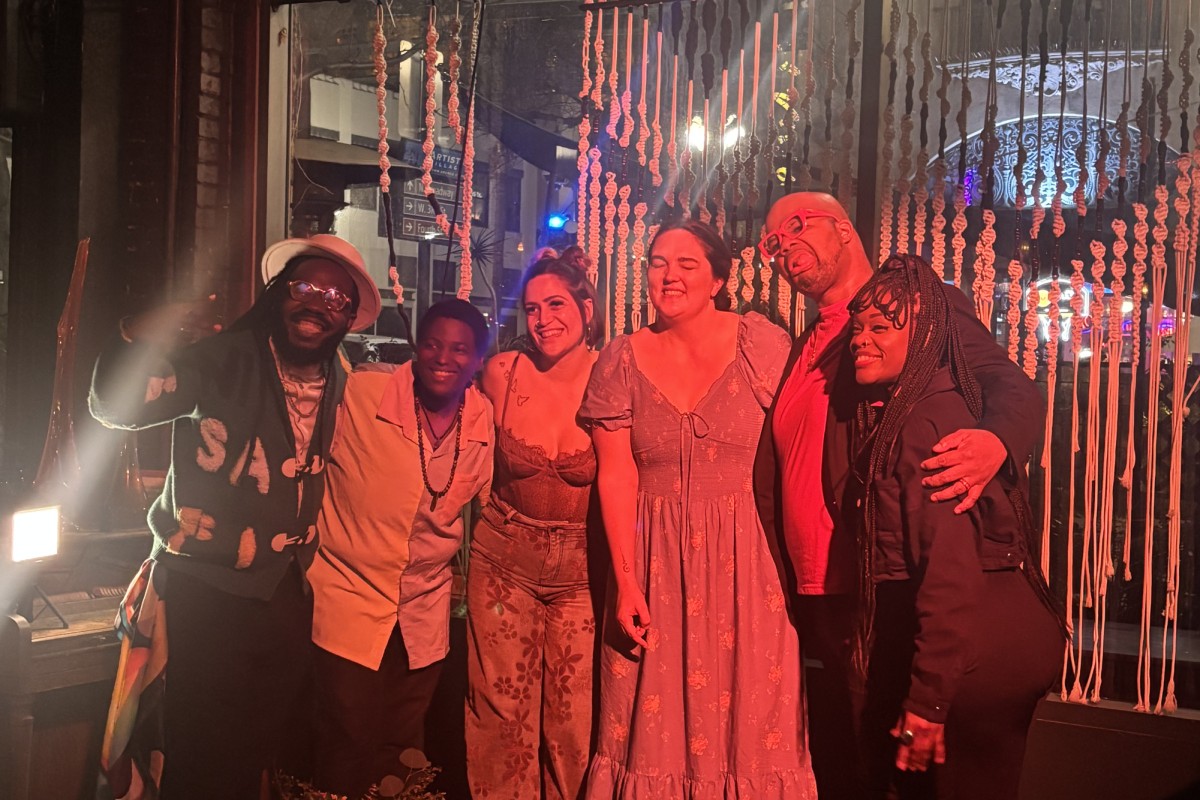
Douglass, now 30, is still active in the spoken word poetry space, performing at slam poetry competitions and hosting events under the name “Celia DaPoet.” They recently qualified for the 2026-27 OC Poetry Slam team which represents Orange County in regional & national poetry competitions.
Through this, they have joined a rising scene in Orange County dedicated to the writing and performance of poetry. In recent years, the spoken word poetry scene in Orange County has grown, with events such as the OC Poetry Slam and SAUSD LitCon exemplifying this ever growing interest. Through this, poets of all ages have impacted both their communities and themselves.
Douglass reflects on what clicked for them about spoken word poetry, which was the competitive side of it.
“I was like, ‘I want to do that for the rest of my life.’ I was like ‘Poetry and competition in one?’ because beforehand, I was playing basketball. I wanted to go to the WNBA. I was traveling a lot playing ball. Once I saw slam poetry, I was like ‘This is it. This is the goal,” Douglass said.
Spoken word poetry has its meaning in the name; it is poetry written with the intention of being performed in front of an audience. It can incorporate elements such as hip-hop, theater, and storytelling, and it may be accompanied by music, sound, dance, or more. Spoken word poetry originates all the way back to the older cultures, when the act of performing poetry was necessary to influence others.
For Peter Lechuga, a local 38-year-old spoken word poet and activist, spoken word poetry is not all that different from standard written poetry. However, he does recognize a difference in its impact depending on the medium.
“I feel poetry is just poetry, and the only real difference is that you’re out there connecting with people one-on-one, whereas, when people read your books on a page, they’re connecting on a personal level, but they’re not experiencing it, like one-on-one…but you can gain a lot from reading on a page,” Lechuga said.
Lechuga began writing poems as a child but only began getting seriously involved in the spoken word poetry community around 2023, whether it was attending open mics or organizing events. Through this, he has provided social and political commentary he believes is vital.
“I’m a very political poet. I like talking life through poetry. Innately, intrinsically, it’s very political, because we’re very much writing about our personal experience, of what’s happening right now, and right now, being a Chicano under this current administration, my existence is political,” Lechuga said.
Lechuga does also write about his personal life, and through his experience in the poetry scene, he has observed the impact that poems have had on others.
“People have told me I’ve inspired them to write poetry themselves or to be more involved in activism… I feel like poetry can do everything from angering people to making them [feel] catharsis,” Lechuga said.
Through writing and performing, Lechuga has also noticed the impact of poetry on himself as well. He noted the calmness he feels and the feeling of freedom he had from revealing his thoughts.
“There’s definitely been some things that I’ve, like, tried to oppress or not really [comment] on fully, and then when I write these things down, it’s cathartic. It helps to heal some of that pain and trauma that I’ve experienced… so writing this down, processing it, and then telling a story is healing in a beautiful way,” Lechuga said.
As for Douglass, they have witnessed this impact extend to youth poets. As a former youth poet themself, they had personal knowledge on how spoken word poetry helped them both find their voice and connect with others.
“I think those places [poetry events] are perfect for youth to express themselves, especially now in what’s happening in the country, on people being silenced. I think poetry is a way for youth to say what you’re gonna say and speak up for what you believe in, and I think it’s a beautiful way for them to connect with fellow youth, with the world,” Douglass said.
One such youth poet is Lesslie Manso-Moreno, a junior at Godinez Fundamental High School. She competed in LitCon, an event hosted by SAUSD which seeks to highlight student writers, which she held appreciation for.
“It was really fun. I got to explore a lot of different aspects of community and society today that I thought were really important to talk about, and I got to do it in a creative manner,” Manso-Moreno said.
Manso-Moreno, aside from LitCon, participates in poetry otherwise, whether it is writing for national competitions, performing it at Speech & Debate tournaments, or just writing it recreationally. Similar to Lechuga, Manso-Moreno also noted a sense of catharsis when participating in the activity.
“It’s a creative outlet for me, because there’s no rules, and I find it to be a really liberating artform, because it’s like music. It’s like dancing. It’s like acting. I think it’s the best example of all the art forms combined into one, and I feel like it’s one of the forms of self-expression that has the most soul,” Manso-Moreno said.
Manso-Moreno, specifically regarding the performance of her writings, felt that she was able to re-evoke the feelings she had when writing into her performance. The act of performing, to her, helped elevate her poetry.
“Whatever emotion I had while writing, I also evoked it through my writing whilst performing. I think it was a cool experience getting to experience the same emotion twice, once while writing and once while performing,” Manso-Moreno said.
Specifically in spoken word poetry, there exists a sub-category known as slam poetry. Slam poetry is a competitive form of spoken word poetry where judges score poets on the quality of their writing and performance. Originally starting in Chicago in the early 1980s, the activity expanded in 2024 to Orange County when the OC Poetry Slam team was founded. As mentioned before, Douglass qualified to enter the team this year, and they looked back at the qualifying tournament fondly.
“The competition itself was tough. There were six of us for finals [in February], but the competition started in September, because you had to qualify [in preliminary slams] to be in the finals… it’s not just one night. It’s months and months preparing and learning for those slams, and just being able to hit final stage of trusting my poems, and putting in the work, and asking even my fellow competitors ‘Hey, how are you feeling about this?,’” Douglass said.
Despite the fact that they had to compete against other poets, Douglass did not view their competitors with any sort of negativity. Rather, they maintained a friendly connection with them.
“I knew a lot of the poets from outside of competition. I’m friends with them, I talked with a lot of them outside competing, at open mics, and so, to me, I was like, hey, we might be on a team together. Why not start asking more on ‘What are you writing about?’ or ‘What are your ideas?’ because eventually, whoever I’m competing against will be my teammate,” Douglass said.
Douglass also acknowledged a difference between preparing for a poetry slam versus competing in traditional spoken word poetry. Rather than just worrying about an audience, one has to prepare for the judges and their fellow peers.
“When you prepare for a slam, there’s so many factors that are taken into it. It’s the type of poem, it’s where you’re placed in a bout, and in a bout, there’s either one to six positions, so it depends on where you are in that bout, because if you start one, the judges are just warming up,” Douglass said.
Douglass, despite having a lighthearted tone to their poems that contrasted with their competitors’ seriousness, was unphased by the differing poems. Rather, they decided to express themselves in their own manner, in spite of the competition.
“Even going into that slam, it sounded like everyone was doing some serious poems, like serious topics, and I was like ‘What’s a poem that I would do that I think would be funny to do, and that’s, like, silly-coded?,'” Douglass said.
For those wanting to begin watching spoken word poetry, Lechuga had words of wisdom. He encouraged those interested in watching spoken word poetry to find local events and try to engage with the poets’ work.
“If you just want to enjoy poetry, y’know, go to shows. Look ’em up. I think there’s an Instagram account; I think it’s called ‘LA Poets’ or something like that, and you can just find spoken word events that are happening in your city. Go and support! People would love to have you in the audience, hear their work, and then you can talk to them after, and hear more about a specific poem that you liked or something that you related to, and you can get really involved because there’s so many talented writers down here in Southern California, and in OC, there’s so many,” Lechuga said.
As for people wanting to instead write and perform poetry themselves, Manso-Moreno encouraged them to face their fear. She pointed to poetry not needing to be as complicated as it may seem; she suggested avoiding overthinking about writing and performing poetry.
“For people trying to get into poetry, don’t think that you need to make rhymes. Remember, freestyle, freeverse, is a poetry type, so remember that you can write anything. It doesn’t need to rhyme, it doesn’t need to have, like, verses, it doesn’t need to have a motif. It’s whatever you want to put on paper. Remember that there is no wrong way to write a poem,” Manso-Moreno said.
As for how youth specifically can enter, Douglass echoed this encouragement. They suggested to ease oneself into performing in front of others rather than immediately worrying about the big stage, and they reiterated the value that poetry can have for people’s voices and how their perspective matters.
“There might be some fear there. You can do it! Get to a mic, share your poem with someone, anyone that you trust, and start there. If a mic is a little too scary for you, share with someone that you trust, then go to a bigger group, and then go to an open mic. Your story, your poetry, what you have to say matters, and your poem deserves to be heard, so why not share it?” Douglass said.