


























You don’t deserve to think. You don’t deserve legs. Your voice doesn’t matter.
Being told such things can feel like an attack on one’s character. Unfortunately, this is the message some individuals receive in the Santa Ana community and throughout the country. This issue is something many deal with daily, only it is often hidden to the public eye.
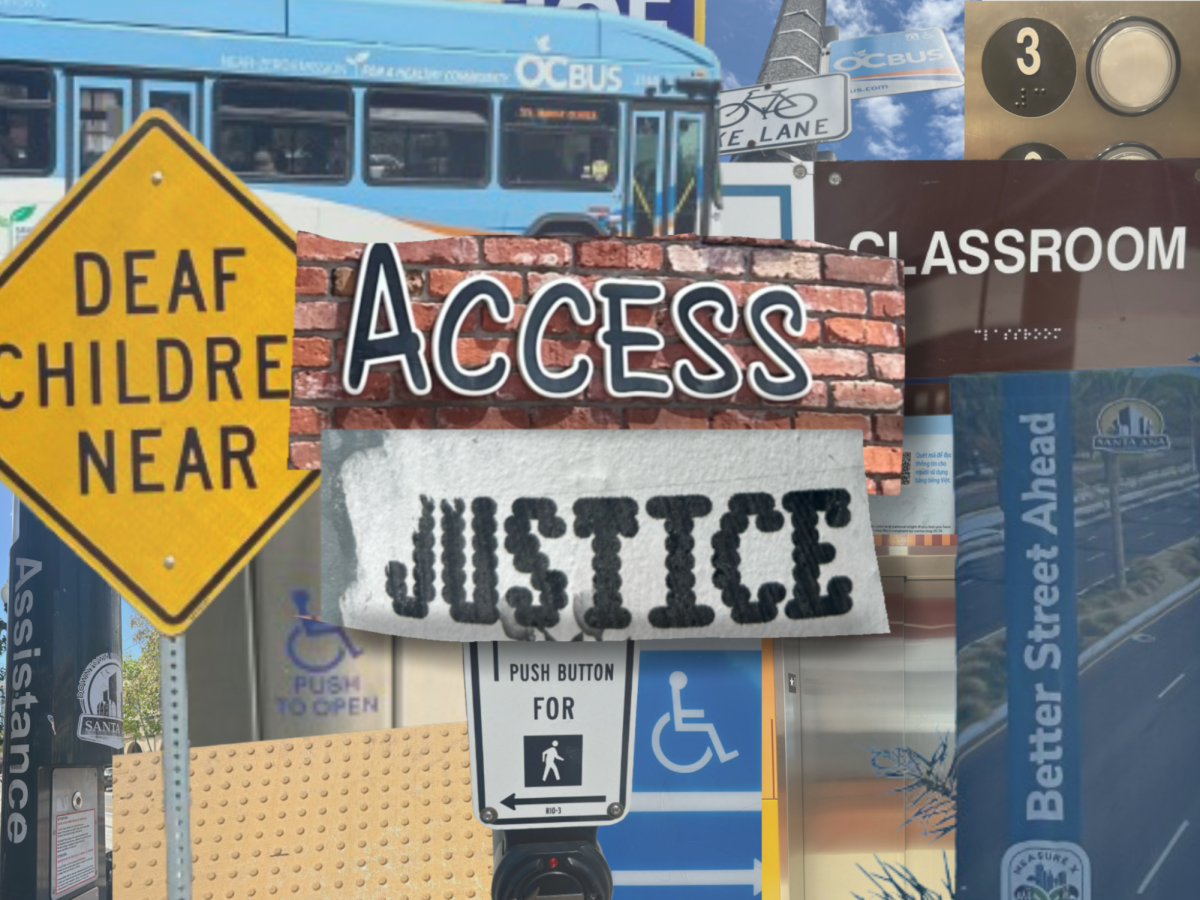
Having access to the ability to perform and function is a right that everyone deserves.
Accessibility isn’t about equal treatment but equity for all. Having access isn’t a single battle but a war fought by many families and collectives with a shared interest and desire for a future and commitment towards justice. Whether in terms of learning, mobility, or communication, the fight to ensure an equitable and fair world has been constantly fought for within Santa Ana. Despite these challenges, community members have gathered together to recognize these problems and continue their commitment to fighting for accessibility.
LEARNING ACCESSIBILITY
Scott Werner is Middle College’s current principal, handling all matters in terms of academic accessibility and ensuring a secure and effective school environment. Werner has served as Middle College’s principal for nearly an entire school year but holds decades worth of experience as Segerstrom High School’s assistant principal. Through his years, he has grown to understand that education isn’t simply a narrow structured pathway for all.
“The systems that we have in place here are: ‘Let’s talk to the math teacher!’, ‘Let’s make sure that we try to get some tutoring!’, ‘What other things are barriers that are getting in your way?’ And so we try that at a very classroom level, counseling level, school administration level to find out what is the difference that student actually needs. Because realistically, the deeper I’ve gone into education, the more individualized education has been,” Werner said.
The experience of education varies with individual students. Within recent years, educators have learned to better understand this. The format of a narrow linear structure of digesting and demonstrating learning isn’t always the best solution for all.
“I can run a report and say, ‘Oh, okay, well, you guys that have lower than a 75%, go to tutoring’ but that doesn’t necessarily fit every single student,” Werner said.
The lost emphasis of mandatory tutoring in Middle College High School was in recognition that everyone’s situation is different. Struggling students aren’t inherently “lazy” or refuse to do assignments. Rather, people have personal matters or a difference in learning that may be affecting their performance. Basing one’s learning on a percentage rather than individual needs has proven to be an imperfect system.
In Santa Ana Unified School District, staff and teachers are working constantly with students in efforts to better rework systems to accommodate the needs of all students. Biology and CTE Laura Compton has decades of experience as a teacher and she’s used her platform as an educator to not only build the futures of her students but also ensure empathy and understanding in her instruction. Growing up as a neurodivergent youth, Compton expresses her struggles growing up cognitively different and how she’s used her struggles to empower a brighter future.
“I was undiagnosed in elementary school because no one really knew what that was. I was always the kid who was fidgeting and doing things and calling out and things like that,” Compton said, “As a teacher, I make sure that I am cognizant of different learners like myself. Growing up, it was always you do it this way, it has to be that way and if you don’t do it this way, then you’re penalized, whereas that was just horrid for me.”
Growing up with such differences in learning ability and little resources to rely on in such a limited environment can prove poor for those who are neurodivergent. According to Compton, an accessible future for all involves ensuring variety and empathy.
“Offering students ways to show their learning in different ways is so important because obviously, you know, I’m not incompetent. It’s just remembering that there are so many different kinds of people and just because someone doesn’t do it one way doesn’t mean that they can’t do it another,” Compton said.
People can’t always sit down and write an entire paper singlehandedly. For the future, education in Santa Ana is being driven by availability of resources and opportunities.
“The goal should be showing that you know it. The ways to get there should be however it is easiest or best for that individual. I think having lots of different options, lots of different opportunities, is the best way of showing your knowledge of the content,” Werner said.
MOBILITY ACCESSIBILITY
Accessibility isn’t limited to education but also desired in the means of infrastructure of a city. Having the ability to move without difficulty and get to the places is a need. However, accomplishing this need is difficult when certain streets are limited to motorized transportation. City Councilmember and representative of Ward 3 in Santa Ana, Jessie Lopez, discusses how the city of Santa Ana has aimed to create a more accessible future through all means. Growing up in Santa Ana and now a representative for the city, she notes how the city of Santa Ana has sought a financial pledge towards architectural betterment.
“We’ve invested millions into our infrastructure, supporting modernization in Ward 3 and throughout the entire city to not just be compliant with state and federal laws, but to really be responsive to a California that is aging, to a Santa Ana that is aging,” Lopez said.
Santa Ana is a city that has more pedestrians than a typical Orange County city for the fact that many residents can’t afford a car. To appeal to all who rely heavily on being able to move themselves from one place to another, investment in infrastructure has become crucial. This effort isn’t only to give individuals mobility but also a means to fight the ever-growing concern for pedestrian deaths.
“The number one reason that people are dying in our public streets is because of pedestrian death,” Lopez said, “The news will cover homicide but they never talk about the number of people that are dying and the impact on families that are feeling that death because of poor street design, because of speeding, because streets like Bristol and Warner continue to be expanded and made into these massive arterial streets that do not provide (a level of) safety.”
Individuals without automobiles are disregarded in their ability to navigate their travels. Recent improvements to local streets have been visible via the fixed curbs to walk trip-free, speed bumps to fight speeding, and bikeable streets to build a future not purely reliant on automobiles. Such ideals are driven by community-based efforts like The Vision Zero Initiative.
“The Vision Zero initiative that the city adopted years ago is a very powerful initiative. Vision Zero really is like a framework, a guiding tool that tells jurisdictions like ours, these are the policies that you can implement, the design that you can help implement to really reduce and eliminate pedestrian death in your city,” Lopez said.
Community-driven initiatives like Vision Zero has helped communities nationally battle traffic-caused deaths and is one of many resources Santa Ana has relied on to reduce civilian deaths. With time, Santa Ana has also seen implementation locally via ADA laws.
“We are always striving to be in compliance with ADA laws, not just because they’re the laws and we must abide by them but because most importantly, it really signals to our community that we’re being thoughtful and that we’re thinking about people’s differences in terms of lived experiences, how they approach life overall, and ultimately to help provide a need that exists in the city,” Lopez said.
The Americans with Disabilities Act has been a national tool used to plan Santa Ana’s infrastructure. Mobility has grown to become a need for many. Middle College Class of 2026 senior Luis Pasaye had recently experienced temporary injury preventing locomotor mobility. Having recovered from his broken leg, Pasaye highlights his experience on this.
“It wasn’t until [my injury] that I truly realized how privileged I was to have a functioning body. Just living, just being around the house and going to school was incredibly harder to do. Everything became inconvenient, and it really was a struggle to just do basic stuff,” Pasaye said.
Pasaye relied on the elevator at school but found it difficult in unmodernized places he went to in the city.
Development for change has built Santa Ana into being a more walkable city. However, changes like such don’t simply come from the hands of those in power. Without regular residents advocating for their right to walk where they desire, Santa Ana wouldn’t see the projects in the works today.
“It’s understanding how, if we’re going to rip up a street, then how are we going to improve that street in the best possible way that is smart, defendable, that takes that to account for how people move in our community of all ages and how ultimately do we center a people-centered design,” Lopez said.
LINGUISTIC ACCESSIBILITY
Ensuring accessibility is based on more than just variety in the ability to learn or navigate but also in the ability to communicate. Santa Ana boasts a diverse community, ranging from those of Spanish speaking descent to Vietnamese speaking descent. Understanding accessibility in the sense of language is vital. Leonel Flores is Green MPNA’s community organizer and a Santa Ana-born citizen and advocate. As Program Lead for the CUAL Committee, a community-based air monitoring network serving Santa Ana’s Madison Park neighborhood, Leonel highlights the importance of language accessibility.
“To me, accessibility means having information that’s readily available and easily digestible; that it’s presented in a way that everybody can understand, but also that it’s available in the languages of the communities that are being affected, not just in English,” Flores said.
With the variety of languages available, addressing the barriers between communication between all ethnicities and backgrounds is becoming a stronger demand as our world progresses.
“Concern for accessibility becomes an issue when you’re not communicating in a language that’s accessible for the communities you’re trying to work with or the communities that are being affected,” Flores said.
If a change is known to affect everyone in the community, there is a moral right to make sure all in that community recognize this change in effect and how that will impact them. Such a statement is easier said than done. Oftentimes, the means to communicate this is disregarded resulting in formal essential letters written or vital conversations held strictly in English. As a result, many communities, especially ones disadvantaged in the ability to communicate, will not be properly informed.
“Especially when it comes to public issues and working with communities of color, disadvantaged communities, all communities in general, there should always be language accessibility,” Flores said.
Santa Ana has a community experiencing barriers in language communication. When language is only limited to English, communities of color are forced to adapt to a language they may not as easily grasp.
“There’s a lot of code specifically that references to working class Latinos or working class people of diverse backgrounds of trying to really limit their economic opportunity and that was rooted in this racist belief or view of how Santa Ana should be in the future from the previous predominantly white governing body that existed for a very, very long time,” Lopez said.
The disregard of language accessibility has historically resulted in a form of discrimination against communities of color. These historical injustices are ones still being handled today.
“Some of the work that we’re still trying to dig through (is) to really figure out how do we help correct some of these historical injustices that have kept people out of public spaces and that have made people like you and like myself and like our parents and our neighbors feel unwelcome or not be respected or be seen entirely,” Lopez said.
Historical injustices have kept people away from being active in the city they belong in. Barriers in communication have only worsened the health and environment surrounding residents. Flores explains a way in which inadequate language accessibility has impacted Santa Ana.
“There was a company that was moving into our neighborhood that was requesting a permit to emit dangerous chemicals into our air. Because it was within a thousand feet of a couple of schools and residential areas, the agency that was issuing this permit had to send out a notice to the residents in case they wanted to object to the permit. But when they sent out this notice, it was sent out only in English when most of our community is monolingual Spanish-speaking. So many of our residents became worried, became scared because they could tell it was some official letter, but they didn’t know what it said. Unfortunately, by the time they reached out to us at the school, the comment period had already ended. So this facility basically moved into our community, even though residents did not want it there. And pretty much ever since, we’ve been having lots of issues with this facility, all because there wasn’t language accessibility in that notice,” Flores said.
In a way, the limited communication to those with power is normalizing covert racism. The disregard for language access has harmed the communities already most troubled. Despite the problems built by inadequate communication, battles were fought towards ensuring such an occurrence never happens again.
“I personally wouldn’t say the city has fought for language accessibility. I think we’ve had to pressure the city and we’ve had to demand that from the city for it to happen… I think it was made possible because of people from the community demanding these accessibility needs that they happen,” Flores said.
Coalitions and initiatives were initiated to recognize the unfairness of limited communication and improve language accessibility. Through months of meetings with representatives for planning and building and the former mayor and city councilmembers, their desire for such change was eventually recognized.
“We fought a lot for language accessibility and because of that, the city of Santa Ana now publicizes everything in English, Spanish, and Vietnamese, which are the biggest communities in Santa Ana,” Flores said.
Such an effort has helped ensure communication equity. By providing translational resources in these prominent languages, our city has grown closer to becoming a welcoming environment for members of the community to voice their opinions and contribute to an ever growing world.
EMPOWERMENT
In light of how Santa Ana residents have fought for documents written in a variety of languages, this proves people can and will fight for equity.
“I think empathy really is missing,” Compton said. “Those of us who are neurodivergent have to speak up and have to remember that we have a voice and we deserve to learn. We are just as capable as any other people.”
Accessibility in Santa Ana is a commitment that is driven by the community within. If people weren’t willing to advocate, we wouldn’t have the same world we see today.
“That work hasn’t come from the government. That work has come directly from the advocacy that our families have done in the city for years,” Lopez said.
Through all the efforts between local schools, the city, and the people within, equity has been a long fought battle towards a future where all reserve the ability to think without limitations, walk to where they need to be and speak their mind. Even still, accommodations for all have still remained limited.
Building a fully equitable world might be unrealistic but aiming to create one shouldn’t be dismissed.
“For me, accessibility isn’t just a one-time fix or a one-time project. That’s an ongoing commitment of understanding who our community is and the future of our community,” Lopez said.