
















Admiration for A-listers has been around for decades: the flashing lights of the paparazzi, the invasive gossip from tabloids, and scandalous headlines; it all feeds a fandom’s obsession. Now, with social media spreading to each corner of the world, fans can admire the content of their favorite celebrities at the click of a button.
Being starstruck is a feeling most people can relate to: the excitement of hanging up your favorite singer’s poster, or the joy of watching interview clips of your favorite actors. But in the midst of the craze, it’s important to recognize the fine line between adoration and obsession. Within a celebrity’s admirers there is a fraction of their fan base that disregards the underlying fact that, despite feeling like you may know them, they are still complete strangers.
‘Celebrities, they’re just like us!’
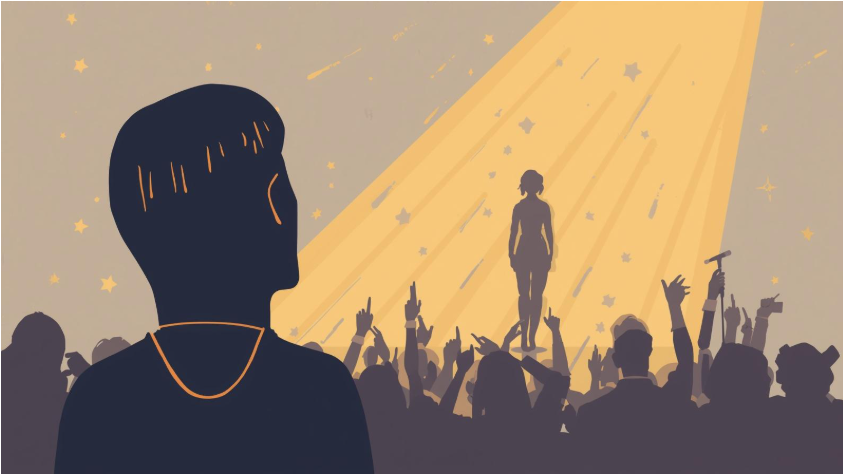
Parasocial relationships are described as one-sided, psychological bonds where an individual invests emotional energy and physical time into a public figure that is unaware of their existence.
This unrequited devotion is not to be mistaken for any run-of-the-mill celebrity crush. As explained by Santa Ana College psychology professor, Jeffrey Pedroza, individuals who hold parasocial tendencies run in different lanes than the average fan.
“Parasocial relationships imply a one-sided very intimate relationship towards a celebrity. This is much more intense than being a fan,” Pedroza said.
To dive deeper into the reason behind why celebrities are so adored, it is important to recognize the three tiers of parasociality.
At the tip of the iceberg, there are entertainment-social bonds—which is where the majority of a fan base falls into. These fans enjoy and appreciate the content of their favorite celebrities, so-much-so they share their interest with those around them. But when this feeling intensifies, we cross into intense-personal relationships. This is where a fan’s adoration fades into obsession; this smaller part of a fandom personally internalizes a celebrity’s values, and even considers them as part of their inner circle. Finally, in the depths of a fan base—about 3% to 5% of fans—there are those who indulge in borderline-pathological relationships. These individuals are willing to do anything for their favorite celeb, including illegal activities.
A common factor among die-hard and newly introduced fans is that they all fall into one of the ranks, but these separate links are not to be mistaken for another. Each bond carries its own unique characteristics.
Entertainment-Social Bonds
This lower level of celebrity worship classifies a greater amount of a fan base—those with light-hearted intentions. Think of it as following your favorite musician, or liking a celebrity because of their charisma and fun personality.
“We desire to know them and believe they [celebrities] will easily fall into our ‘friend’ circle. Our dopamine spikes when we see them, so we want to see them more,” Pedroza said.
Unsurprisingly, this type of fan tends to be outgoing—the kind of person who bonds with others over a shared love of the same artist or actor. The celebrity becomes a kind of glue who brings people together. For the most part, the mental health effects reflect that. Fans in this tier tend to carry a greater sense of optimism, sociability, and overall happiness.
Intense-Personal Relationships
When admiration deepens into something more personal, the dynamic begins to shift. In intense-personal relationships, the celebrity starts to feel less like a public figure and more like someone you actually know—a close friend, or even a romantic partner. Their highs become your high and their lows hurt you directly.
“I believe we identify similar characteristics with celebrities, so we believe they know and understand us,” Pedroza said. “Since we believe we are in a relationship with a celebrity, all ranges of emotions are in play.”
This level of fandom is linked to more emotional and nervous personality traits, and with that comes a heavier mental toll. Fans in this tier are more likely to experience symptoms of anxiety and depression, so they lean on their parasocial world as a way to escape real-life problems rather than face them.
Borderline-Pathological
There are also those who fall into the deepest end. Borderline-pathological fans are willing to do almost anything for their favorite celebrity. They begin spending beyond their means, convincing themselves the celebrity would love them back if they just had the chance to meet—and in extreme cases, crossing legal lines. In these cases reality and fantasy begin to blur.
“Like any obsession, when it does not pass and starts to interfere with our functionality, it can turn into emotional dependency,” Pedroza said.
Pedroza also noted that individuals with real or perceived abandonment issues may be especially vulnerable to falling into this category.
“I believe individuals with real or perceived abandonment issues are more likely to be involved with parasocial relationships,” Pedroza said.
At this stage, the parasocial bond becomes addictive, and the mental health consequences follow. This tier has been linked to narcissism, anti-social behavior, and tendencies toward criminal activity and addiction.
Most fans exist in the entertainment-social space, where admiration is harmless and even enriching. The concern arises when the one-sided bond starts to feel more real than relationships right in front of you. In an age where social media is designed to keep you endlessly engaged, recognizing that line and choosing to step back from it may be the most important thing a fan can do.